The Cosmic Tekton: From Cain’s City to the New Jerusalem
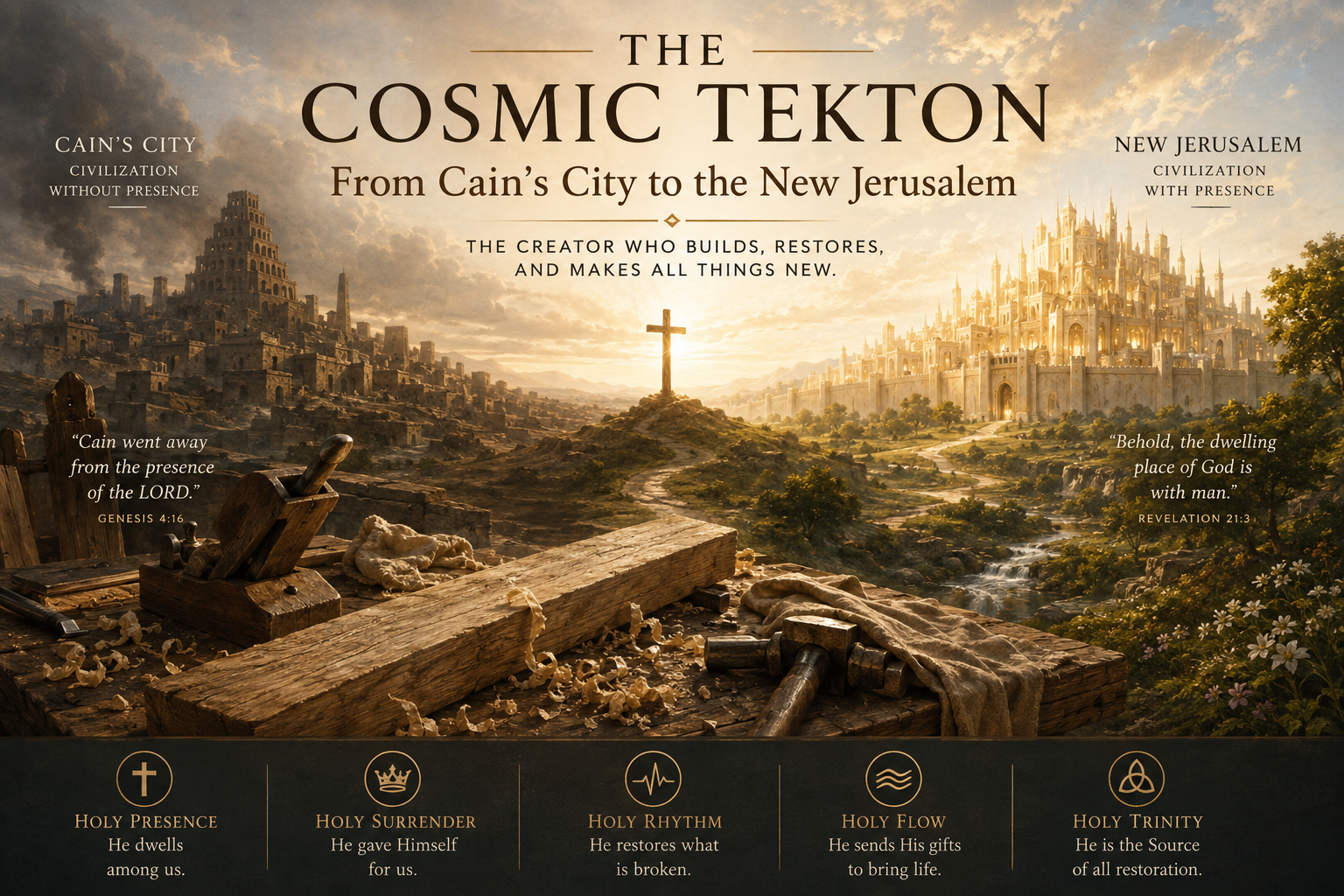
THE COSMIC TEKTON
From Cain’s City to the New Jerusalem
Rev. Dr. James Hwang
Genesis 4, the Hidden Life of Jesus, and a Canonical Theology of the Restoration of Civilization
ABSTRACT
Genesis 4 presents one of Scripture’s earliest and most profound accounts of the emergence of human civilization. Cain builds a city; his descendants develop pastoral economy, music and the arts, metallurgy, and increasingly complex forms of social life. Yet these remarkable cultural achievements unfold within a genealogy also marked by jealousy, murder, violence, and the escalating vengeance of Lamech.
The problem, therefore, is not civilization itself. The decisive theological detail appears immediately before Cain’s city-building project: Cain “went away from the presence of the LORD” (millifnê YHWH, מִלִּפְנֵי יְהוָה; Gen. 4:16).
Genesis 4 may thus be read as an archetypal account of civilization without Presence—human beings developing culture, technology, economic structures, and cities while increasingly detached from the presence, lordship, and moral order of their Creator.
The biblical canon, however, does not culminate in the abolition of civilization. It culminates in a city—the New Jerusalem—filled completely with the presence of God (Rev. 21–22). Between Cain’s city and the New Jerusalem stands the decisive event of the biblical story: the incarnation of the Creator within human civilization.
The New Testament identifies Jesus Christ both as the One through whom all things were created (John 1:1–3; Col. 1:15–17; Heb. 1:2) and, strikingly, as ὁ τέκτων (ho tekton), the craftsman or builder of Nazareth (Mark 6:3). The Creator entered His creation not merely as an observer but as an embodied participant in ordinary human life and labor.
The canonical paradox is extraordinary:
The Builder of the cosmos became the tekton of Nazareth.
Although the Gospels provide little direct information concerning the approximately eighteen years between Jesus’ appearance in the Temple and the beginning of His public ministry, these years should not be regarded as an empty interval. Jesus grew to adulthood within the concrete world of Galilean labor, family, agriculture, construction, village economy, and social relationships. Moreover, Nazareth lay only a few miles from Sepphoris, which underwent substantial reconstruction and urban development under Herod Antipas during a period overlapping Jesus’ youth and early adulthood. While no surviving evidence proves that Jesus worked on a particular building in Sepphoris, the possibility that a tekton family from nearby Nazareth participated directly or indirectly in its construction economy deserves serious historical consideration.
Equally significant is the remarkable density of occupational and material imagery in Jesus’ teaching: houses and foundations, stones and towers, fields and vineyards, seeds and harvests, shepherds and sheepfolds, laborers and wages, debts and stewards, lamps and bread, garments and wineskins. These parables cannot simply be reduced to autobiography; nevertheless, it is highly plausible that Jesus’ prolonged immersion in the actual world of Galilean work and ordinary life formed an important experiential soil from which the language and imagery of His kingdom proclamation emerged.
This study therefore proposes that Jesus Christ should be understood canonically not only as the Savior of individual souls but as the Cosmic Tekton—the Creator who entered fallen civilization, bore its violence upon the cross, inaugurated new creation through His resurrection, formed a new humanity through the Spirit, and ultimately restores human culture to the presence and purposes of God.
I. CREATION BEFORE CIVILIZATION
Civilization Was God’s Idea Before It Became Cain’s Project
A biblical theology of civilization cannot begin with Genesis 4. It must begin with Genesis 1–2.
Humanity is created in the image of God and commissioned to be fruitful, multiply, fill the earth, and exercise responsible dominion over it (Gen. 1:26–28). In Genesis 2:15, the human being is placed in the garden to work it (ʿavad, עָבַד) and keep it (shamar, שָׁמַר).
Human beings are therefore cultural creatures before they are fallen creatures.
They receive creation and cultivate its possibilities.
They name.
They order.
They build.
They nurture.
They create relationships.
They transform raw potential into meaningful forms of life.
Creation → Cultivation → Culture
Culture is not an accidental consequence of sin. Neither are labor, creativity, social organization, or technological development inherently rebellious.
The fundamental problem of civilization is not that humanity creates.
It is that humanity attempts to create without the Creator.
II. GENESIS 3
Before Civilization Lost Its Way, Humanity Lost the Presence
The first great catastrophe of the Fall is not technological impoverishment.
It is alienation from God.
Adam and Eve hide:
“from the presence of the LORD God”
(Gen. 3:8).
Then comes the divine question:
אַיֶּכָּה — Ayyekkah?
“Where are you?”
(Gen. 3:9)
In Genesis 4 the question changes:
אֵי הֶבֶל אָחִיךָ — ʾÊ Hevel ʾaḥikha?
“Where is Abel your brother?”
(Gen. 4:9)
The movement is profound:
Where are you?
↓
Where is your brother?
Biblical spirituality can never remain merely vertical.
Divine Presence creates human responsibility.
The person who encounters God must eventually answer the question of the brother.
Thus genuine Presence must become embodied love.
III. ABEL AND CAIN
Living Worship and Worship Without Surrender
Before Genesis 4 gives us a city, it gives us an altar.
Both Cain and Abel bring offerings.
Yet the text states that the LORD regarded:
“Abel and his offering”
but did not regard:
“Cain and his offering”
(Gen. 4:4–5).
The worshiper and the offering belong together.
Hebrews interprets Abel’s sacrifice through the category of faith:
“By faith Abel offered to God a more acceptable sacrifice than Cain”
(Heb. 11:4).
Read canonically alongside Romans 12:1, Abel anticipates the logic of the living sacrifice:
Offering + Offerer = Living Worship
Cain, by contrast, brings an offering while withholding himself.
Jealousy remains.
Anger remains.
Self-rule remains.
His brother becomes a rival.
God warns him:
לַפֶּתַח חַטָּאת רֹבֵץ
la-petaḥ ḥaṭṭāʾt rovets
“Sin is crouching at the door”
(Gen. 4:7).
Cain’s tragedy is therefore not that he practiced no religion.
He worshiped.
But his worship did not become surrender.
Offering without Surrender becomes Dead Ritual.
This pattern reverberates throughout Scripture—from Isaiah’s critique of sacrifice without justice (Isa. 1:11–17), through Amos’ rejection of worship divorced from righteousness (Amos 5:21–24), to Jesus’ insistence that reconciliation with one’s brother belongs to true worship (Matt. 5:23–24).
IV. CAIN’S CITY
Civilization After the Loss of Presence
Genesis 4:16 contains a crucial theological transition:
וַיֵּצֵא קַיִן מִלִּפְנֵי יְהוָה
Vayyetse Qayin millifnê YHWH
“Cain went away from the presence of the LORD.”
Immediately thereafter:
“Cain built a city”
(Gen. 4:17).
The narrative sequence is striking:
Presence Lost
↓
City Built
This does not mean that the Bible condemns cities as such. Scripture will ultimately end with the holy city.
Rather, Cain’s city raises a deeper question:
What happens when civilization begins to perform functions that humanity once received from God—security, identity, permanence, significance, and a name?
Cain had been sentenced to wandering (Gen. 4:12), yet he builds a city.
The theological danger is therefore:
God as Security
↓
Civilization as Security
Human structures become substitutes for divine Presence.
Civilization ceases to be stewardship under God and becomes a mechanism of autonomous self-preservation.
V. THE MAGNIFICENT AMBIGUITY OF CIVILIZATION
Cain’s descendants achieve remarkable cultural developments.
Jabal represents pastoral and economic specialization.
Jubal represents music and the arts.
Tubal-cain represents metallurgy and technological skill.
Together they suggest:
City + Economy + Art + Technology
Scripture does not describe these developments themselves as evil.
Indeed, later Scripture will incorporate architecture, craftsmanship, music, precious metals, and sophisticated artistry into the worship of God itself (Exod. 31:1–11; 1 Kings 6–7; Ps. 150).
The problem lies elsewhere.
Within the same genealogy appears Lamech.
His song celebrates disproportionate violence:
“I have killed a man for wounding me…”
(Gen. 4:23).
Cain’s sevenfold vengeance becomes Lamech’s seventy-sevenfold boast.
Human tools become more sophisticated.
Human hearts do not necessarily become more humane.
Genesis therefore anticipates one of the great truths of human history:
Technological Progress ≠ Moral Progress
Civilization can advance while humanity deteriorates.
VI. FROM CAIN TO BABEL
When Civilization Seeks Its Own Name
Genesis 11 expands Cain’s pattern from family history into collective civilization.
Humanity declares:
וְנַעֲשֶׂה־לָּנוּ שֵׁם
ve-naʿaseh-lanu shem
“Let us make a name for ourselves.”
(Gen. 11:4)
Now the elements converge:
City, technology, centralized power, human achievement, self-created identity.
The trajectory becomes:
Cain → Lamech → Babel
The issue is not brickmaking.
The issue is the human attempt to build transcendence without God.
Civilization has become liturgy.
The city itself has become an altar to the human name.
VII. TWO CITIES ACROSS THE CANON
From this point onward, Scripture develops two contrasting trajectories of civilization.
One moves through:
Babel → Egypt → Babylon → Imperial Rome → Babylon the Great
The other moves through:
Eden → Tabernacle → Jerusalem → Christ → Church → New Jerusalem
The deepest biblical contrast, therefore, is not simply:
city versus wilderness
but:
Civilization without Presence
versus
Civilization filled with Presence
This distinction becomes decisive for understanding the incarnation.
VIII. NAZARETH AND SEPPHORIS
The Historical Landscape of the Hidden Jesus
Mark 6:3 preserves an extraordinary description of Jesus:
οὐχ οὗτός ἐστιν ὁ τέκτων;
Ouch houtos estin ho tekton?
“Is not this the tekton?”
Matthew 13:55 similarly remembers Him as the son of a tekton.
The Greek τέκτων need not be restricted to the modern image of a furniture carpenter. In its ancient setting it could designate a craftsman or builder working with materials such as wood and stone and participating in the broader world of construction and repair.
This matters because Nazareth did not exist in geographical isolation.
Only several miles away stood Sepphoris, a major Galilean center extensively rebuilt under Herod Antipas during a period overlapping Jesus’ youth and early adulthood.
Three historical considerations therefore deserve to be held together:
Jesus grew up in Nazareth.
Jesus was remembered as a tekton.
A substantial urban construction economy existed within walking distance during His formative years.
No surviving text places Jesus at a particular Sepphoris building site. Such specificity would exceed the evidence.
Yet the opposite assumption—that a working tekton family in nearby Nazareth necessarily remained untouched by one of the region’s most significant construction projects—is equally unwarranted.
The historically responsible conclusion is therefore positive but measured:
Direct documentary proof is absent, but the possibility that Jesus and/or Joseph participated, directly or indirectly, in the construction economy associated with Sepphoris possesses substantial historical and socioeconomic plausibility.
The significance is considerable.
Jesus may have grown up not merely within a secluded agricultural village but at the intersection of village life and urbanization, agriculture and construction, subsistence and commerce, Jewish tradition and Herodian political economy.
This would provide a remarkably concrete social landscape for His later proclamation of the Kingdom.
IX. THE HIDDEN EIGHTEEN YEARS
Formation Before Manifestation
The years between Jesus’ appearance in the Temple and the beginning of His public ministry are often described as the “hidden years.”
Hidden, however, does not mean empty.
Luke closes the infancy narrative with a deceptively simple statement:
“Jesus increased in wisdom and in stature and in favor with God and man”
(Luke 2:52).
These were years of formation.
Years of family.
Years of work.
Years of neighbors.
Years of material reality.
Years of observing wealth and poverty.
Years of learning what things cost, how long work takes, how tools break, how harvests fail, how wages matter, how families struggle, and how communities survive.
The theological significance is profound.
The Son of God did not merely assume a human body.
He inhabited ordinary human life.
The incarnation penetrated the workshop as surely as it entered the synagogue.
X. THE HIDDEN LIFE AND THE PARABLES
When Lived Experience Becomes Kingdom Language
Jesus’ parables should not be reduced to literal autobiographical transcripts of His hidden years. Yet neither should the extraordinary relationship between His teaching and the concrete world in which He had lived for decades be minimized.
It is highly plausible that Jesus’ prolonged immersion in Galilean life and labor supplied a major experiential reservoir for the imagery through which He later proclaimed the Kingdom of God.
Consider the remarkable range.
Construction
The house on rock and sand
(Matt. 7:24–27)
The unfinished tower
(Luke 14:28–30)
The rejected stone becoming the cornerstone
(Matt. 21:42)
Foundations, doors, houses, walls, measurements.
Agriculture
The sower.
The soils.
The weeds.
The mustard seed.
The vineyard.
The fig tree.
The harvest.
Pastoral Life
Shepherds.
Sheep.
Sheepfolds.
Gates.
Lost animals.
The yoke.
Household Life
Bread.
Leaven.
Lamps.
Lost coins.
Patched garments.
Wineskins.
Labor and Economy
Day laborers.
Wages.
Debtors.
Creditors.
Stewards.
Landowners.
Taxes.
Talents.
Accounts.
These images possess an unmistakable material texture.
They smell of soil.
They carry the weight of stone.
They know the anxiety of the worker waiting to be hired.
They understand the vulnerability of debt.
They know the difference between a sound foundation and a collapsing house.
Thus a historically and theologically fruitful conclusion becomes possible:
The hidden years of Jesus were very likely an important experiential soil in which the language, imagery, and social perception of His later Kingdom proclamation matured.
The Kingdom was not announced in the vocabulary of abstraction.
Jesus spoke heaven in the language of earth.
He transformed the ordinary grammar of human civilization into the vocabulary of divine revelation.
XI. THE COSMIC CREATOR BECOMES THE VILLAGE TEKTON
Here the historical question opens into Christology.
John declares:
“All things were made through him”
(John 1:3).
Paul writes:
“By him all things were created”
(Col. 1:16).
Hebrews declares that God made the ages through the Son (Heb. 1:2).
And yet Mark calls Him:
ὁ τέκτων — the tekton.
The canonical paradox could hardly be greater.
THE COSMIC CREATOR
↓
THE NAZARETH TEKTON
The One through whom trees came into existence worked with wood.
The One who formed mountains handled stone.
The One who established the foundations of the earth knew the weight of foundations laid by human hands.
The One who sustains all things entered the fatigue of human labor.
The Builder of the cosmos became a village builder.
The hidden life of Jesus therefore confers extraordinary theological dignity upon ordinary work.
XII. FROM TEKTON TO RESTORER
The Public Ministry as Restorative Construction
When Jesus emerges into public ministry, the scale of His building work changes.
Now He begins rebuilding human beings.
Broken bodies are healed.
Shattered identities are restored.
The excluded are returned to community.
Sinners receive forgiveness.
The possessed are liberated.
Enemies are commanded to become objects of love.
The forgotten are called by name.
The dead are raised.
Isaiah had envisioned the Messiah as the One who would bind up the brokenhearted and rebuild ancient ruins (Isa. 61:1–4). Jesus deliberately appropriates this prophetic horizon in Nazareth (Luke 4:16–21).
Thus His ministry can be understood as:
RESTORATIVE CONSTRUCTION
The tekton now rebuilds humanity.
XIII. JESUS REVERSES CAIN’S CIVILIZATION
The canonical contrasts are striking.
Cainic Civilization
Presence abandoned
City as self-security
Self-made name
Possession
Domination
Rivalry
Violence
Vengeance × 77
Brother’s blood shed
Civilization for self
Christic Restoration
Emmanuel—God with us
Kingdom as divine gift
The Father’s name
Stewardship
Servanthood
Brotherhood
Enemy-love
Forgiveness × 70×7
Christ’s blood given for His brothers
Civilization redirected toward love
Cain asks:
“Am I my brother’s keeper?”
(Gen. 4:9)
Jesus declares:
“The good shepherd lays down his life for the sheep.”
(John 10:11)
Cain’s logic is:
My brother dies so that I may prevail.
Christ’s logic is:
I die so that my brothers may live.
XIV. ABEL’S BLOOD AND THE BLOOD OF CHRIST
After Abel’s murder God tells Cain:
“The voice of your brother’s blood is crying to me from the ground”
(Gen. 4:10).
Hebrews deliberately returns to Abel:
Jesus’ sprinkled blood “speaks a better word than the blood of Abel”
(Heb. 12:24).
Abel’s blood cries for justice.
Christ’s blood does not abolish justice; it carries justice through atonement toward reconciliation.
Abel’s Blood
Justice
↓
Christ’s Blood
Justice + Mercy + Reconciliation
The bloodshed inaugurated in Cain reaches its redemptive reversal at Calvary.
XV. LAMECH’S SEVENTY-SEVEN AND JESUS’ RADICAL FORGIVENESS
Lamech celebrates escalating vengeance.
Jesus commands escalating forgiveness (Matt. 18:21–22).
The canonical reversal is beautiful:
LAMECH MULTIPLIES REVENGE
↓
JESUS MULTIPLIES FORGIVENESS
Christ restores civilization first by restoring its relational rhythm.
Before society can be healed structurally, the cycle of retaliation must be broken spiritually.
XVI. THE CROSS
Where Civilization’s Violence Reaches Its Limit
At Golgotha, the powers of fallen civilization converge.
Religious authority.
Political authority.
Imperial power.
Military violence.
Judicial procedure.
Economic interest.
Crowd psychology.
Public spectacle.
All converge upon one body.
The body of Christ.
Yet something unprecedented happens.
Violence reaches Christ,
but violence does not pass through Christ.
He does not return hatred for hatred.
The ancient rhythm of Cain and Lamech reaches the cross—and there encounters self-giving love.
The cross is therefore not merely the salvation of isolated souls.
It is God’s judgment upon the violent logic of fallen humanity and the revelation of an entirely different form of power:
Cruciform Power.
XVII. RESURRECTION
The Architect Begins Again
Christianity does not end at the cross.
The crucified Tekton rises.
Paul therefore speaks of:
καινὴ κτίσις — kainē ktisis
“new creation”
(2 Cor. 5:17).
In 1 Corinthians 15, Christ appears as the last Adam.
The first Adamic humanity culminates in death.
The risen Christ inaugurates life.
Thus:
CROSS
↓
RESURRECTION
↓
NEW CREATION
Jesus is not merely repairing fragments of the old creation.
He inaugurates the new.
The tekton of Nazareth becomes the Architect of New Creation.
XVIII. PENTECOST
Babel Reversed Without Diversity Destroyed
The relationship between Genesis 11 and Acts 2 is equally suggestive.
At Babel, human self-exaltation culminates in linguistic fragmentation.
At Pentecost, the Spirit descends and people from many nations hear the mighty works of God in their own languages.
BABEL
Unity without God → Fragmentation
PENTECOST
Diversity in the Spirit → Communion
The Spirit does not erase languages.
He creates communion through them.
God’s answer to Babel is therefore not uniformity.
It is reconciled diversity.
Pentecost becomes the social beginning of new creation.
XIX. THE CHURCH
A Prototype of the Civilization of Presence
Acts 2:42–47 and 4:32–35 portray a community in which:
Worship,
Teaching,
Prayer,
Meals,
Economic sharing,
Hospitality,
Joy,
Mission,
and care for the vulnerable
belong together.
The Church is therefore more than a religious institution.
At its best, it is:
A PROTOTYPE OF RECONCILED HUMANITY
and:
AN ALTERNATIVE CIVILIZATION OF PRESENCE.
It anticipates, imperfectly but genuinely, the world toward which resurrection is moving history.
XX. FROM CAIN’S CITY TO THE NEW JERUSALEM
The Bible begins with a garden.
Remarkably, it does not end merely by returning humanity to a garden.
It ends with a:
Garden-City.
Revelation 21–22 integrates:
Nature,
Architecture,
Human community,
Nations,
Beauty,
Precious materials,
Kingship,
Culture,
Worship,
The river of life,
The tree of life,
and the immediate presence of God.
The decisive declaration is:
“Behold, the dwelling place of God is with man.”
(Rev. 21:3)
Genesis 4 gives us:
A city built after leaving the Presence.
Revelation 21 gives us:
A city completely filled with the Presence.
The biblical story therefore does not culminate in the abolition of civilization.
It culminates in its redemption.
Civilization is not discarded.
Civilization is purified, reconciled, restored, and glorified.
XXI. THE GRAND CANONICAL ARC OF CIVILIZATION
The entire biblical narrative may now be viewed as a magnificent movement:
GENESIS 1
Creation
↓
GENESIS 2
Cultivation
↓
GENESIS 3
Alienation
↓
GENESIS 4
Civilization without Presence
↓
GENESIS 11
Civilization for the Human Name
↓
ISRAEL
Presence among a People
↓
THE PROPHETS
Justice, Mercy, and Restoration
↓
INCARNATION
God Enters Human Civilization
↓
NAZARETH
The Creator Becomes Tekton
↓
THE MINISTRY OF JESUS
Restorative Construction
↓
THE CROSS
Violence Absorbed and Judged
↓
THE RESURRECTION
New Creation Inaugurated
↓
PENTECOST
A New Humanity Empowered
↓
THE CHURCH
A Prototype Civilization of Presence
↓
THE NEW JERUSALEM
Civilization Glorified in the Presence of God
XXII. THE 5H FRAMEWORK
A Theology of Civilizational Restoration
1. Holy Presence
The first question of civilization is not:
What can we build?
It is:
Who dwells among us?
Cain builds after departing from Presence.
Christ enters civilization as Emmanuel.
The New Jerusalem becomes the city in which Presence is complete.
Therefore:
Have you encountered the Presence?
Then embody that Presence in work, culture, community, and city.
2. Holy Surrender
Cain offers something without surrendering himself.
Christ gives Himself.
Philippians 2:5–11 reveals the opposite of Cainic self-assertion: divine greatness expressed through self-emptying love.
Thus Christian civilization begins not with acquisition but surrender.
Have you confessed Surrender?
Then place your talent, wealth, technology, authority, and very self upon the altar.
3. Holy Rhythm
Creation itself moves in a restorative rhythm:
Chaos → Order
Emptiness → Fullness
Darkness → Light
Brokenness → Restoration
Death → Life
Cain distorts that rhythm:
Worship → Jealousy → Violence → Power → Revenge
Christ restores it:
Presence → Service → Healing → Forgiveness → Cross → Resurrection
Therefore:
Have you discovered the Rhythm?
Then actually restore what has been broken.
City → Community
Economy → Stewardship
Technology → Service
Art → Beauty
Power → Protection
Competition → Cooperation
Vengeance → Forgiveness
Brokenness → Restoration
Holy Rhythm is not merely something to contemplate.
It must become reconstruction.
4. Holy Flow
In Cainic civilization:
Skill → Power → Self
In Christ:
Gift → Service → Life
Every gift becomes holy when it flows outward in love.
Knowledge must flow.
Wealth must flow.
Technology must flow.
Beauty must flow.
Healing must flow.
Grace must flow.
Have you spoken of Holy Flow?
Then let what God has entrusted to you actually become life for others.
5. Holy Trinity
The ultimate source of restoration is not human idealism.
It is the life of the Triune God.
The Father is the fountain of creation and love.
All things are created through the Son.
The Spirit hovers over creation and gives life.
In redemption, the Father sends, the Son gives Himself, and the Spirit communicates the life of the risen Christ to humanity.
Thus the final purpose of civilization is neither prosperity nor technological supremacy.
It is:
Participation in the Creative, Redemptive, and Self-Giving Love of the Triune God.
XXIII. EVERY VOCATION AS RESTORATIVE TEKTON-WORK
The theology of the tekton ultimately transforms vocation.
The physician becomes a:
Tekton of Broken Bodies
The teacher:
Tekton of Minds
The entrepreneur:
Tekton of Economic Ecosystems
The architect:
Tekton of Human Habitats
The artist:
Tekton of Beauty
The scientist:
Tekton of Knowledge
The pastor:
Tekton of Souls and Communities
The peacemaker:
Tekton of Broken Relationships
Christian vocation therefore asks not merely:
“How can I succeed?”
but:
“What has been broken here, and how may I participate in Christ’s work of restoration?”
This is vocation transformed into discipleship.
This is labor transformed into worship.
This is civilization transformed into stewardship.
CONCLUSION
Jesus Christ, the Cosmic Tekton
Genesis 4 confronts us with one of Scripture’s deepest paradoxes.
Human civilization advances magnificently.
Cities arise.
Economies develop.
Music is created.
Metals are forged.
Technology progresses.
Yet the human heart remains capable of jealousy, murder, domination, and revenge.
Scripture therefore refuses to equate civilization with salvation.
Its ultimate question is not:
How advanced have we become?
but:
In whose Presence are we building?
And here the Christian gospel makes its astonishing claim.
The One through whom the universe was made entered the world He had made.
The Cosmic Creator became the Nazareth Tekton.
He did not save humanity from a safe distance.
He entered ordinary human life.
He worked.
He touched materials.
He lived within family and community.
He knew the world of fields and vineyards, houses and foundations, wages and debts, shepherds and laborers.
It is highly plausible that these long years of embodied life and labor became an important experiential soil from which the extraordinary material richness of His Kingdom teaching later emerged.
Then the Tekton stepped beyond the workshop.
He began rebuilding people.
He restored bodies.
He reconciled sinners.
He reconstituted community.
He confronted domination.
He broke the rhythm of vengeance.
Finally, fallen civilization placed Him upon a cross.
But the violence of Cain could not have the final word.
The Tekton rose.
And with His resurrection, construction began again.
CREATOR OF THE COSMOS
↓
TEKTON OF NAZARETH
↓
SERVANT OF HUMANITY
↓
CRUCIFIED RECONCILER
↓
RISEN LORD
↓
ARCHITECT OF NEW CREATION
The biblical drama therefore stretches from one city to another.
Cain builds a city after leaving the Presence of God.
At the end of Scripture, God gives humanity another city in which His Presence can never again be lost.
Between those two cities stands Jesus Christ.
He is the bridge between creation and new creation, between human labor and divine restoration, between the broken civilization of Cain and the radiant civilization of the New Jerusalem.
The thesis of this study may therefore be stated in its final form:
Jesus Christ is the eternal Logos through whom all things were created, the Nazareth Tekton who entered the concrete world of human labor, and the Cosmic Architect who, through His incarnation, cross, resurrection, and the gift of the Spirit, restores humanity, work, culture, community, and civilization to the presence and purposes of the Triune God, bringing the biblical story from Cain’s city to its glorious consummation in the New Jerusalem.
Or, in its most concentrated form:
Cain built a city without Presence.
Christ entered civilization bearing the Presence.
The Cross broke its cycle of violence.
The Resurrection inaugurated its restoration.
The Spirit is building a new humanity.
The New Jerusalem completes the Civilization of Presence.
The Christian calling, therefore, is neither to abandon civilization nor to worship it.
It is to restore it.
To bring work back into worship.
Power back into service.
Technology back into stewardship.
Art back into beauty.
Economy back into generosity.
Community back into reconciliation.
And civilization itself back into the Presence of God.